People Strategy
The Future of Work and Solving East Africa’s Skills Alignment Gap
By Wanjira Mbuthia · 12 Sep 2026 · 6 min read
People Business Partner, Future-Fit Consultants | Nairobi, Kenya
Diagnosing Talent Misalignment in East Africa
According to The International Journal of Research and Innovation in Social Science (2024), Africa’s youth unemployment rate was estimated to grow from 10.7% in 2020 to 42% in 2030 with the current education and training. According to the National Council for Population and Development, Youth (15 – 34 year old), who form 35 percent of the Kenyan population, had the highest unemployment rate of 67 percent in 2017. The major cause of unemployment was found to be various types of mismatches. The general objective of the study was to find out the mismatch between skill acquisition at the university and the absorption at the job market. According to the study, Seventy five percent (75%) of the sample size confirmed a mismatch of what they learned at university level and what was required in their industrial attachment. Sixty five percent (65%) of the graduates were in a vertical education mismatch employment and 35% were still searching for employment. Hence, the problem facing East Africa’s labour market is not a shortage of ambition or intelligence. It is a profound, structural skills mismatch.
Our tertiary education system remains heavily weighted toward producing generalists in business administration, humanities, and general accountants; while the market’s expanding frontiers urgently demand high-level technical, digital, and operational specialists.
Traditional Graduate Output | Critical Market Deficit | |
General Business Administration | SKILLS MISMATCH | Commercial Agronomists and Agri-SCM |
Social Sciences and Humanities | Advanced CNC & Industrial Automation Maintenance | |
General ICT and Web Development | Foundational AI Architecture & Deep Learning | |
Financial Accounting | Agentic AI & Predictive Financial Analytics |
1. Kenya: The digital ecosystem is mature, but enterprise transitions toward cloud-native systems, cybersecurity, and predictive AI require capabilities far beyond basic computer science degrees. We see dozens of applicants for entry-level IT roles, but securing enterprise-grade DevOps engineers or Cloud Architects requires long headhunting cycles or costly foreign talent. Additionally, emerging FDI and domestic ventures in critical mineral extraction and coastal maritime infrastructure demand specialized capabilities that standard degrees do not provide. Local operations face severe shortages in GIS remote-sensing analysts, environmental compliance auditors certified to international mining standards, modern port automation operators, and maritime cargo handling logistics experts.
1. Tanzania: Mega-infrastructure projects from the Standard Gauge Railway (SGR) to offshore gas developments, major gold/tanzanite mining FDI, and strategic port expansions demand specialized engineering and operational mastery. Local employers regularly face shortages of certified subsea engineers, rail signal mechanics, and port logistics directors. This skills gap is equally critical across the country’s maritime and mining value chains, where there is high demand for subsea petroleum engineers, harbor vessel pilots, maritime supply chain directors, extractive metallurgists, underground rock mechanics specialists, and automated processing plant technicians.
2. Uganda: Key initiatives like the East African Crude Oil Pipeline (EACOP) and commercial agro-processing initiatives require certified high-pressure coded welders (API/ISO), pipeline integrity experts, and industrial agronomists. Yet fewer than 15% of entry-level candidates hold the necessary specialized technical qualifications.
3. Rwanda & Ethiopia: Kigali’s growth as a financial hub (KIFC) and biomanufacturing center creates high demand for financial risk modelers and bioprocess engineers. Similarly, in Ethiopia’s industrial parks and modern mineral processing sites, production is often bottlenecked by a shortage of specialized machinery technicians and extractive metallurgists.
The Strategic Solution: A 5-Pillar Blueprint for Alignment
Resolving this crisis requires shifting from reactive recruitment to proactive talent ecosystem design. Educational institutions, policy bodies, and corporate leaders must move in sync.
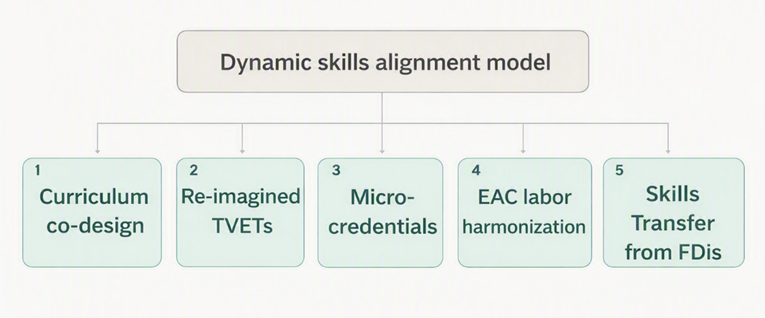
1. Mandatory Curriculum Co-Design
Universities cannot design degrees in isolation. Corporate leaders and industry boards must hold formal seats on university curriculum committees. Coursework needs bi-annual updates guided by real-time market data rather than multi-year academic cycles.
2. Elevate and Modernize TVETs
We need to remove the social stigma around technical and vocational education. TVET institutions should function as high-tech academies focused on robotics, CNC machine operations, precision welding, and advanced port and mining logistics.
3. Modular Micro-Credentials & Dual-Track Apprenticeships
Rather than relying exclusively on four-year degrees, tertiary institutions should partner with industry to offer stackable, 3- to 6-month micro-credentials in specialized tools, cloud platforms, and technical safety standards. Higher education should also integrate structured, paid apprenticeships directly into graduation requirements.
4. Regional Labor Standard Harmonization
Under the EAC Common Market Protocol, cross-border talent mobility needs to be seamless. Standardizing technical qualifications ensures a certified technician or port operations specialist in Dar es Salaam can deploy to Kampala or Nairobi without administrative hurdles.
5. Skills Transfer as a Negotiation Ground for Joint Ventures
Governments and state agencies must treat skills transfer as a fundamental condition in major international joint ventures, foreign investments, and infrastructure concessions. Whether negotiating major port logistics agreements, railway expansions, or mineral mining licenses, foreign operators must be legally tied to clear local capability KPIs, shadow programs, and technology transfer milestones.
The Way Forward for Stakeholders
For Corporate Executives
Stop waiting for academia to solve this problem.
i. Adopt skills-based hiring over rigid degree filters.
ii. Invest directly in internal academies and co-sponsor specialized tracks within TVETs.
iii. Treat vendor and joint-venture negotiations as talent investments by insisting on local upskilling requirements in every major procurement contract.
For Tertiary Education Heads
Shift your institutional focus from graduate volume to specialized market capability.
i. Grant industry advisory boards structural input into curriculum development.
ii. Introduce agile micro-credentials that allow students to stack certifications alongside traditional degrees.
iii. Partner with technology vendors and industrial leaders to equip labs with real-world infrastructure, such as logistics management software, automated robotics, and heavy machinery simulators.
For Government Agencies & Regional Bodies
Policy creates the environment where talent ecosystems thrive or stall.
i. Offer tax credits and matching grants to enterprises that invest in local apprenticeships and TVET infrastructure.
ii. Mandate structured skills-transfer clauses in all public-private partnerships, infrastructure concessions, and mineral extraction contracts.
iii. Harmonize regional professional qualifications across the EAC to enable frictionless workforce movement.
The Bottom Line
East Africa’s economic prospects remain strong. But turning our young workforce into a lasting economic advantage requires deliberate alignment between how we educate and how we build.
When business leaders, educational leaders, and policymakers build talent infrastructure together, we don't just fill job openings, we position East Africa as a global hub for technical excellence.
How is your organization adapting its talent strategy to keep up with industry demands? Connect with our team at Future-Fit Consultants to keep the conversation going.